+91 8013104060
 admission@weaversweb.academy
 500+ Learners
  100+ Got Placed
  50+ Hiring Partners

 Student Portal
 Friday • 8th May, 2026
Usage of mobile apps to order food, book rides, attend online classes, and even manage our money is a common phenomenon these days. In fact, a study by Precedence Research highlights that the expected mobile app market share will reach $1.2+ trillion by 2035. Another study by Sensor Tower states that there is a forecast of about 292 billion global app downloads in 2026. Considering the rampant usage, what has become even more important is a smooth mobile app experience, and it’s up to the skilled app developers to take care of this.
There are many students who want to build such apps but feel confused about where to begin. There are too many programming languages, tools, and courses. Some say learn Android first. Others suggest iOS. This confusion delays action and makes students doubt their choices.
Thanks to React Native, developers can build apps for both Android and iOS. What’s noteworthy is that they use a single codebase for this. Hence, it can be a smart starting point for students who want faster learning and better career opportunities.
What is React Native?
React Native is an open-source framework. It was developed by Meta and is based on JavaScript and React.
You write one codebase and use it to create apps for Android and iOS platforms. That saves a lot of time and effort. Developers are able to work on a single project instead of building separate apps for Android and iOS.
The apps feel smooth and responsive since React Native uses real native components. Many popular apps like Facebook, Bloomberg, and Discord use this framework.
Why React Native is a Smart Choice for Students
When you are at the beginning of your career, choosing which technology to learn is a big decision. Naturally, you want to learn something that gives real results. React Native does exactly that.
- Learn Once, Build for Android and iOS:
Learning React Native is incredibly simple. As mentioned earlier, you write one codebase and have the option to use it for both Android and iOS apps. As a result, you don’t have to learn two separate languages like Java for Android and Swift for iOS. You can accomplish more projects in real time. Moreover, it also improves your portfolio, which helps during placements or internships.
- Strong Demand in the Job Market:
Companies are actively hiring React Native developers. Startups prefer it because it reduces development cost and time. Many businesses want apps for both platforms, but do not want to maintain two separate teams. As a student, learning React Native increases your chances of getting internships, freelance work, or entry-level jobs.
- Easy for JavaScript Learners:
React Native becomes a lot easier if you know basic JavaScript. The syntax is more or less the same. Students who have worked on web development with React will find it smoother. Since you already have a grasp on components, state, and props, you can apply those ideas to mobile apps.
- Faster Development and Real Projects:
React Native supports features like reusable components and hot reload. You can see changes instantly while building your app. This makes learning more interactive and less frustrating. You can start building simple apps early in your course. A to-do app, a weather app, or a basic e-commerce interface, you can build it all. This quick progress makes things interesting for students.
- Strong Community Support:
React Native has a large global developer community with thousands of developers contributing tutorials, open-source libraries, and discussion forums. As a student, you will never feel stuck for too long. If you face an error, chances are someone has already solved it. You can find answers on GitHub, Stack Overflow, or developer communities.
- Better Freelancing and Startup Opportunities:
Many small businesses and startups look for cost-effective app solutions, and React Native is often their first choice. You can start taking freelance projects even before graduation. You can also build your own app ideas without hiring separate Android and iOS developers. This gives you practical experience and even the chance to earn while you learn.
Career Opportunities After a React Native Developer Course
After completing React Native training, many practical career paths open up for you. Let’s have a look:
- React Native Developer:
This is the most direct role. You will build mobile apps for Android and iOS while using a single codebase. Companies always prefer developers who can work on both platforms. As a fresher, you may start by working on features, fixing bugs, and improving app performance.
- Mobile App Developer:
Many companies hire mobile developers with cross-platform knowledge. With your React Native skills, you can work in startups and tech companies that want faster app development. Over time, you can move into senior developer roles.
- Front-End Developer (with Mobile Focus):
If you already know React or JavaScript, React Native adds strong value to your profile. You can work on both web and mobile interfaces. This flexibility increases your chances of getting hired.
- Freelance App Developer:
Freelancing is a good option if you like independent work. Small businesses and startups often look for cost-effective app developers. With React Native, you can deliver apps quickly and manage multiple projects.
Skills You Will Learn in a React Native Course
You won’t be merely learning how to write code in a good React Native Course. It builds your foundation and prepares you to create real mobile apps from scratch. Let’s explore the key skills you will develop:
- Strong JavaScript Fundamentals:
You will strengthen your core JavaScript concepts, such as variables, functions, loops, arrays, objects, and ES6 features. You must have a clear understanding of JavaScript, which is important because React Native is built on it.
- React Basics and Component Structure:
You will learn how React works, including components, props, state, and hooks. Moreover, you can understand how to break an app into small reusable parts. As a result, your code becomes clean and easier to manage.
- Mobile UI Development:
Designing for mobile is different from web design. Creation of responsive layouts, usage of Flexbox and style components, and building user-friendly screens for both Android and iOS are some of the skills you can master.
- Navigation and App Flow:
Every app has multiple screens. So, you need to move between screens, pass data, and manage app flow smoothly using navigation libraries.
- API Integration:
Considering the fact that modern apps connect with servers, you can expect to learn how to collect data from APIs, handle JSON, and display dynamic content inside your app.
- State Management Basics:
Managing data across different screens is one of the non-negotiables. You can master this skill by choosing a comprehensive React Native course. This knowledge of yours will come in handy while building larger and more interactive applications.
- Testing and Debugging:
Finding and fixing errors is an integral part of any React Native developer course. By nurturing your debugging skills, you can build projects more confidently.
- App Deployment:
Finally, you will learn how to prepare and publish your app on the Google Play Store and Apple App Store.
Who Should Enroll in a React Native Course?
There is a common notion that React Native is only for advanced programmers. However, this concept is entirely wrong. It suits many types of students who want to build real mobile apps and grow in this field. If you see yourself in any of the categories below, this course can be a good fit:
- BCA, B.Tech, B.Sc IT, MCA Students:
Students from computer science or IT backgrounds can greatly benefit from this course. It adds a practical skill to your degree.
- Students Who Know Basic JavaScript:
Knowledge of JavaScript fundamentals is key to learning React Native. If you have this knowledge, the learning curve feels smoother and more manageable.
- Beginners Interested in App Development:
Some students want to develop apps without going the long route. Learning React Native is indeed a shortcut since you can come up with apps for both Android and iOS without learning two separate technologies.
- Web Development Learners:
Students learning React for web development can extend their skills to mobile apps. Since the concepts feel familiar, you can grow faster.
- Students Planning Freelancing or Startups:
Choosing React Native over others will be a fruitful decision if you are willing to take client projects or build your own app idea in the near future.
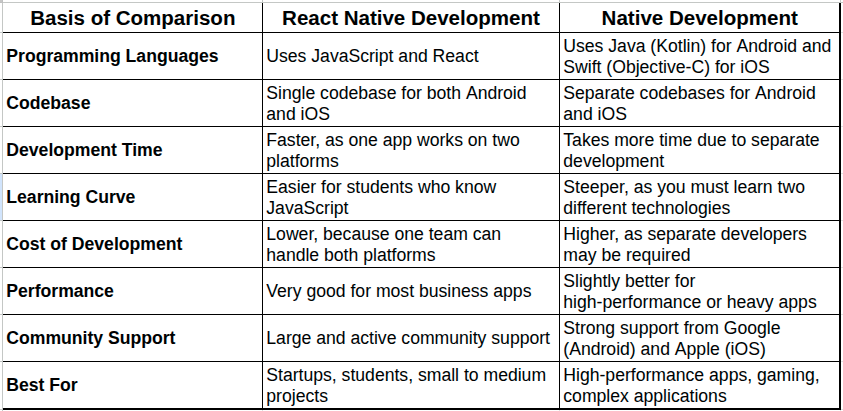
React Native vs Native Development (Brief Comparison)
Things to Consider Before Choosing a React Native Course
There are lots of institutes offering React Native Training, but you have to be careful while making a decision. It’s advisable to keep these points in mind:
- Course Curriculum:
First things first, check what topics are covered. The course should include JavaScript basics, React fundamentals, components, navigation, API integration, and app deployment. If the course skips core concepts, you may struggle later.
- Practical Training:
You must build apps, not just watch videos. So, look for live projects, assignments, and real app development practice.
- Trainer’s Experience:
You have to find out who will teach you. An experienced trainer with industry knowledge can explain real challenges and share practical tips.
- Project Portfolio:
With a good React Native course, you can create 2-3 solid projects. These projects matter during interviews.
- Placement or Career Support:
Some institutes provide interview preparation, resume-building sessions, or placement assistance. This can help freshers a lot.
- Class Format and Support:
Doubts are bound to arise in a learner’s mind while pursuing a course. Hence, you should check if doubt-solving sessions are available. When the batch sizes are small, you get more attention.
- Course Duration and Fees:
You have to compare the duration with the syllabus. If the course is very short, it may rush through topics. Do remember that high fees do not always mean better quality.
Conclusion
Your first tech choice can shape your career for years. React Native gives you speed, flexibility, and real-world relevance. You write code once and see it run on two platforms. That feels powerful. It also makes you more useful to companies and startups that want results without long delays. With the right course and steady practice, you can turn your interest in app development into a serious career path.
Are you looking to give an added dimension to your mobile App Development Career? If so, Weavers Web Academy is the best institute. You can expect our experienced trainers to guide you throughout the course. Moreover, our course modules are job-oriented and help you understand the various concepts associated with React Native.